


May 18, My “Hanai” Mom
This past Sunday, the Honolulu Advertiser ran a “Like a Mother to Me” feature in the Island Life section. A few weeks ago, the editors asked its readers to submit stories of their “hanai” moms, especially for this issue. I am lucky enough to have two great “moms”-one of course, is my “real” mom, and the other, is a Japanese woman named Kyoko Tanaka. So, I submitted my essay, corresponded with the editors, and was included in the section. I was touched and surprised to receive many phone calls from friends, family, and colleagues who shared similar stories, or were somehow affected by mine. Since the paper inevitably made errors (I am NOT getting married this summer, and Kyoko did NOT buy me lunch EVERYDAY) here is the “unedited” but maybe “more boring” version of my hanai mom story: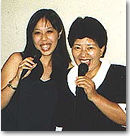 I had to leave in July, and every time the subject came up, she started to cry. “She” is my hanai mom in Japan, Kyoko-san. After living and working in Japan for two years on the JET Program, I was ready to come home to Hawaii, but wished she could come with me.
A new graduate of the University of Hawaii, I left for Japan in the summer of 1996. It was a dream fulfilled-I had always loved Japan, and any anxiety I felt was calmed by total exhilaration. I made the trek to Ikaho, a quaint town of 4,000-some people, and my new home for the next two years. I met Kyoko-san, who would be the new JET liaison for the town.
The first few months weren’t easy. Kyoko-san was my contact for any questions or problems I had, but she spoke no English, and I couldn’t remember anything I learned in Japanese School. Everything little thing became a challenge. I kept wondering why I was stuck with a person who couldn’t even communicate with me. It was frustrating, to say the least.
But somehow, slowly, I learned the language. One day, we found ourselves “hanging out” together; we had become good friends. And suddenly, I started referring to Kyoko-san as “Kyoko-mama.”
She treated me like her own daughter, and did everything from washing my sheets to buying my lunch from the bread wagon every Friday. She worried when I had a cold, and helped me through my first snowy winter. She taught me how to sing Japanese karaoke, showed me the best eateries, and introduced me to all her friends. The best part of it is that of all the things I imagined myself doing in Japan, finding another “mom” wasn’t one of them. It was the most welcomed surprise of the dream I was living.
I still remember her waving from the platform at the train station the day I left. I had taught her how to address a letter to me, and showed her how to make international phone calls. I assured her that we’d see each other again.
Surely enough, I have visited twice since 1998, and she will come to my wedding next summer. We talk regularly on the phone, and share all the wonderful things in our lives. And of course, she was remembered on Mothers’ Day!
|
Susan Sensei’s English Lesson #30(スーザン先生の英語講座 その30) For two years I taught English in Japan, and was “スーザン先生” to my students in Ikaho town, Gunma Prefecture. I will try and introduce new words and phrases for the Japanese visitor to Hawaii. Here is this week’s situation: 【今週のレッスン】 Hanai(ハナイ) = adopted, adoptive(血縁ではないけれど非常に親しく付き合っている ※養子という意味ではありません) Bochaの語源は九州地方の言葉。日系以外の人たちも使っていて「Go bocha」(お風呂に入りなさい)のように使われています。 |
| Loco Girl’s Profile(ロコ・ガールのプロフィール)
Born in Hilo, I grew up going fishing with Dad, shopping with Mom, and trying to be a good “big sister” to a younger sister and brother. A Waiakea High School and the University of Hawaii at Manoa alumni, I taught English in Japan for two years on the JET Program, and am now employed at PacRim Marketing Group, Inc. I love doing a lot of things-shopping, reading, lettering, making jewelry & crafts, watching Friends-and that’s just the start of my list! I like being busy, and am active with the JET Alumni Association (JETAA) and the Honolulu Junior Japanese Chamber of Commerce (HJJCC.) My family and friends are, of course, very important to me, and are why I live a very typical, happy, local-style life in Hawaii and will never leave! |



コメントを残す