


October 4, 2000 Field Trip to Wai`anae
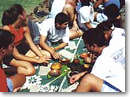 I didn’t really know where Wai`anae was, except that it was pretty far away. Located on the ‘west side’ of `Oahu, Wai`anae doesn’t really have a great reputation. But after a day at the Ka`ala Learning Center, many of us were trying to find ways to get back.
Our MET (Masters of Education in Teaching) instructor, Fred, arranged a one-day excursion for us at the Ka`ala Learning Center last week. With limited knowledge of what we would be doing, many of us were apprehensive at waking up early for the long commute to the “countryside.”
But like the good students we are, we arranged car pools, and navigated through the rain and dirt roads to get to Ka`ala. It was my first time to Wai`anae, and without Teresa’s shotgun instructions, I’d probably have gotten lost. We all got there, bedecked in hiking gear, and waited for the Wai`anae High School Hawaiian Studies Program (HSP) students to arrive.
That day, two busloads of students came to the learning center. Mind you, this ‘learning center isn’t a building, or anything. There aren’t any classrooms, flushing toilets, or telephones. Mentors and teachers conduct lessons with the land, water, and plants as the “classroom.” It is such an awesome place.
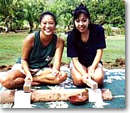 I was a part of the group that studied native plant restoration. On that particular day, the students continued making kapa, or cloth, from the branch of the wauke tree. They had started the project the week before, and continued to beat the kapa, the “real way.” The instructor provided background on the history of the kapa, and talked about “how the Hawaiians did it” while the students continued their work. We also went on to dye the cloths with natural dyes from seeds, roots,berries…everything was “hands on.” The students were also very accommodating, mature, and helped us to understand what they were doing.
We also cleaned, pounded, and ate kalo that had been in the imu overnight. Eating the pa`i`ai afterwards tasted even more ono after working so hard to make it. Kalo is a kind of potato, like taro, and grows in the lo`i, or paddies irrigated with water from the mountains. The lo`i at Ka`ala are hundreds of years old, and have been preserved and restored to be functional even today.
 It was absolutely amazing to find that such a wonderful learning environment exists in the mountains of Wai`anae, or anywhere, for that matter. The Hawaiian Studies Program (HSP) at Wai`anae High School was started five years ago, through a partnership between Wai`anae High School and Ka`ala Farms. It is open to all students at Wai`anae High School, indiscriminative of academic abilities. The HSP curriculum is integrated and incorporates hands-on, collaborative learning methods. The students learn complex concepts like water quality testing and archaeological mapping, but because the environment is so culturally meaningful to them, they take pride and ownership of their learning.
It was such an incredible experience, and Lori summed it best during our debriefing afterwards. She said, “I’d be so proud if I were their teacher.” Maybe one day I’ll have students like that. You are about to check out of your room, and have so many bags to carry to the lobby (from all the shopping you did!) How do you ask for someone to help you?
|
Susan Sensei’s English Lesson #49(スーザン先生の英語講座 その49) For two years I taught English in Japan, and was “スーザン先生” to my students in Ikaho town, Gunma Prefecture. I will try and introduce new words and phrases for the Japanese visitor to Hawaii. Here is this week’s situation: 【今週のレッスン】 “May I have a bellman to room 1234, please?” ベルマンへのチップも忘れずに!通常は荷物ひとつにつき$1が相場ですが、あまりにも荷物がかさばっていたり重かったりしたらもうちょっと渡してあげて良いでしょう。 |
| Loco Girl’s Profile(ロコ・ガールのプロフィール) Born in Hilo, I grew up going fishing with Dad, shopping with Mom, and trying to be a good “big sister” to a younger sister and brother. A Waiakea High School and the University of Hawaii at Manoa alumni, I taught English in Japan for two years on the JET Program, and am now employed at PacRim Marketing Group, Inc. I love doing a lot of things-shopping, reading, lettering, making jewelry & crafts, watching Friends-and that’s just the start of my list! I like being busy, and am active with the JET Alumni Association (JETAA) and the Honolulu Junior Japanese Chamber of Commerce (HJJCC.) My family and friends are, of course, very important to me, and are why I live a very typical, happy, local-style life in Hawaii and will never leave! |


コメントを残す